
Day trading is buying and selling a financial instrument within the same trading day, closing all positions before the market closes. Day traders profit from short-term price moves — minutes to hours — rather than holding for days or weeks. It’s fast, demanding, and one of the hardest ways to make money in markets, but the mechanics are simple to understand.
Before you risk a dollar, you need the basics: what it is, what you need, and what actually separates the winners.
Not sure which style fits your schedule? Our swing trading guide and day trading vs swing trading comparison break down the trade-offs.
What you need to start day trading
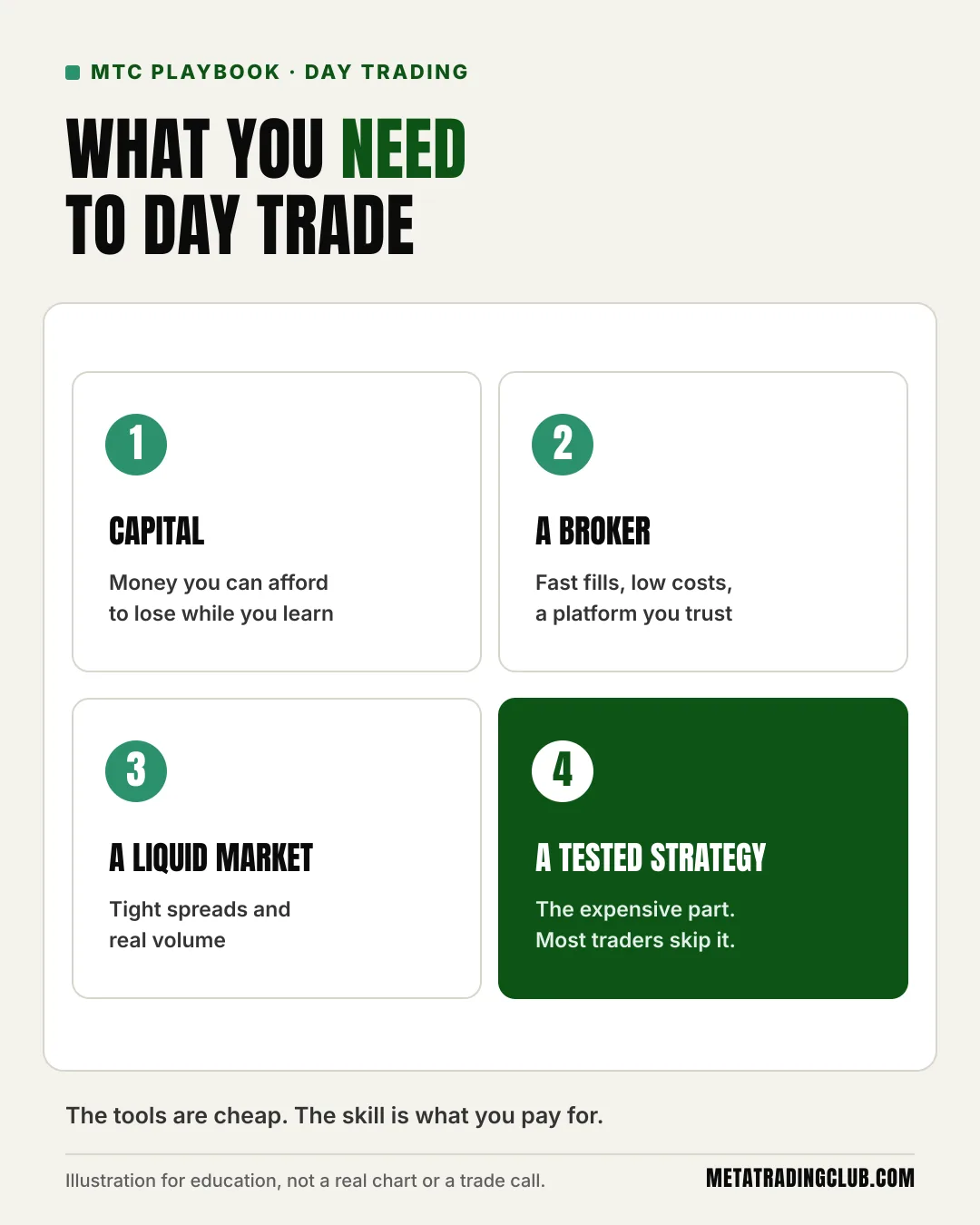
Four things: capital you can afford to lose while you learn, a broker with fast fills and low costs, a liquid market, and a tested strategy. The tools are cheap. The skill is expensive.
For US stocks, the old pattern day trader rule required $25,000 in a margin account to make more than three day trades in five business days. In April 2026 the SEC approved FINRA’s change that replaces that rule with new intraday margin standards, and brokers are switching over on their own timelines. Check what your broker applies today. Our PDT rule guide covers the details, and how much money you need to day trade walks through sizing a small account.
Picking a broker? Start with our day trading broker comparison.
Got a quick question? Our Day Trading FAQ answers 23 of the most common day trading questions, from the PDT rule to taxes.
The upside and the cost of day trading
Day trading has real advantages. You go home flat, so an overnight headline can’t gap your position. You get feedback on your process every single day. And you get a lot of reps, which is how skill gets built.
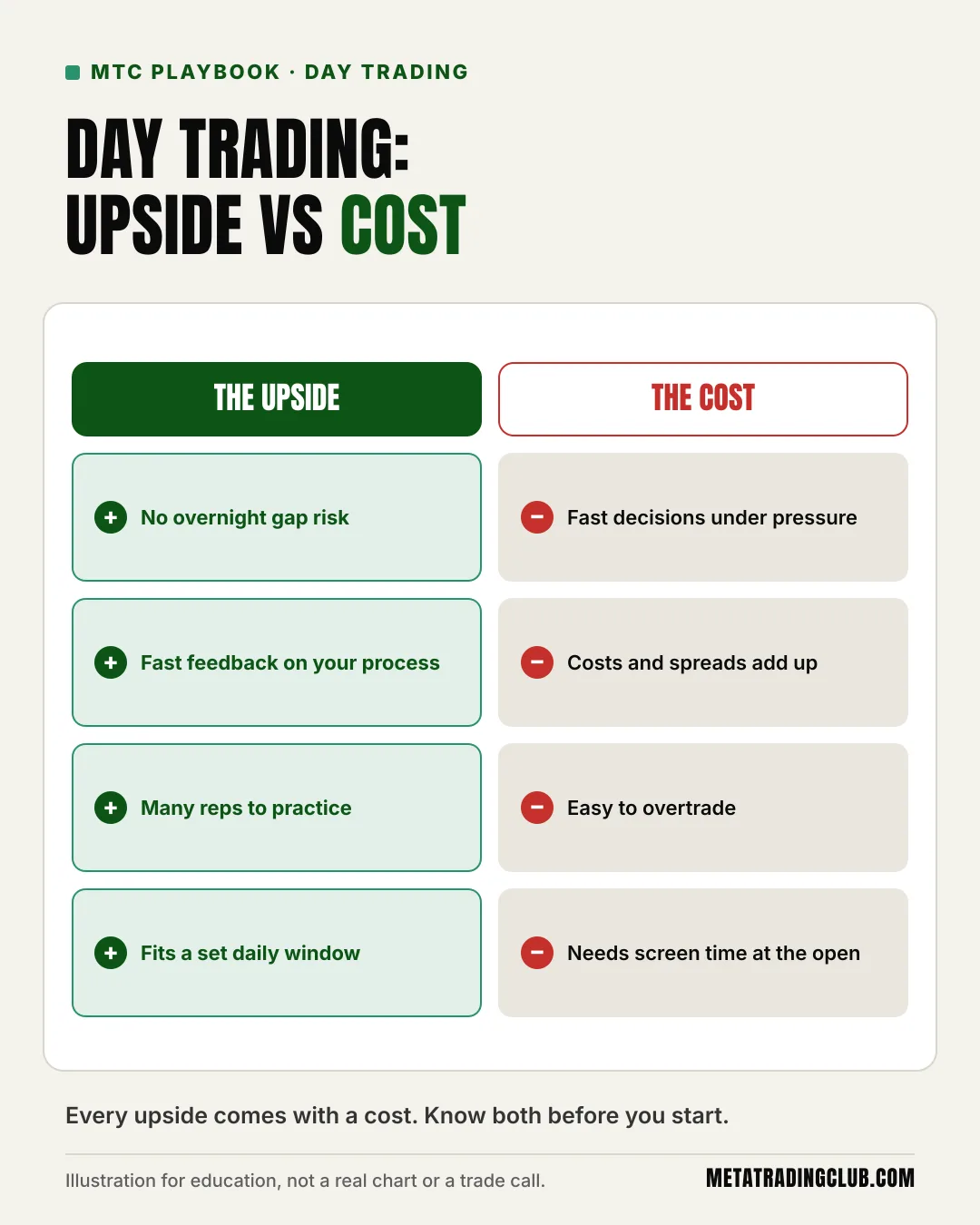
The costs are just as real. Decisions happen fast, commissions and spreads add up across many trades, and it’s easy to overtrade after a loss. If you can’t watch the market during your trade window, swing trading may fit your life better.
How day traders actually make money
Day traders don’t predict the future — they exploit repeatable short-term patterns with a defined edge. They enter on a specific setup, risk a small fixed amount, and take profits at planned targets. The winners aren’t right more often; they lose small and win bigger, and they execute the same process hundreds of times. Consistency, not brilliance, is the engine.
What a day trading day actually looks like
Good day traders run the same routine every day. The trading itself is a small part of it.
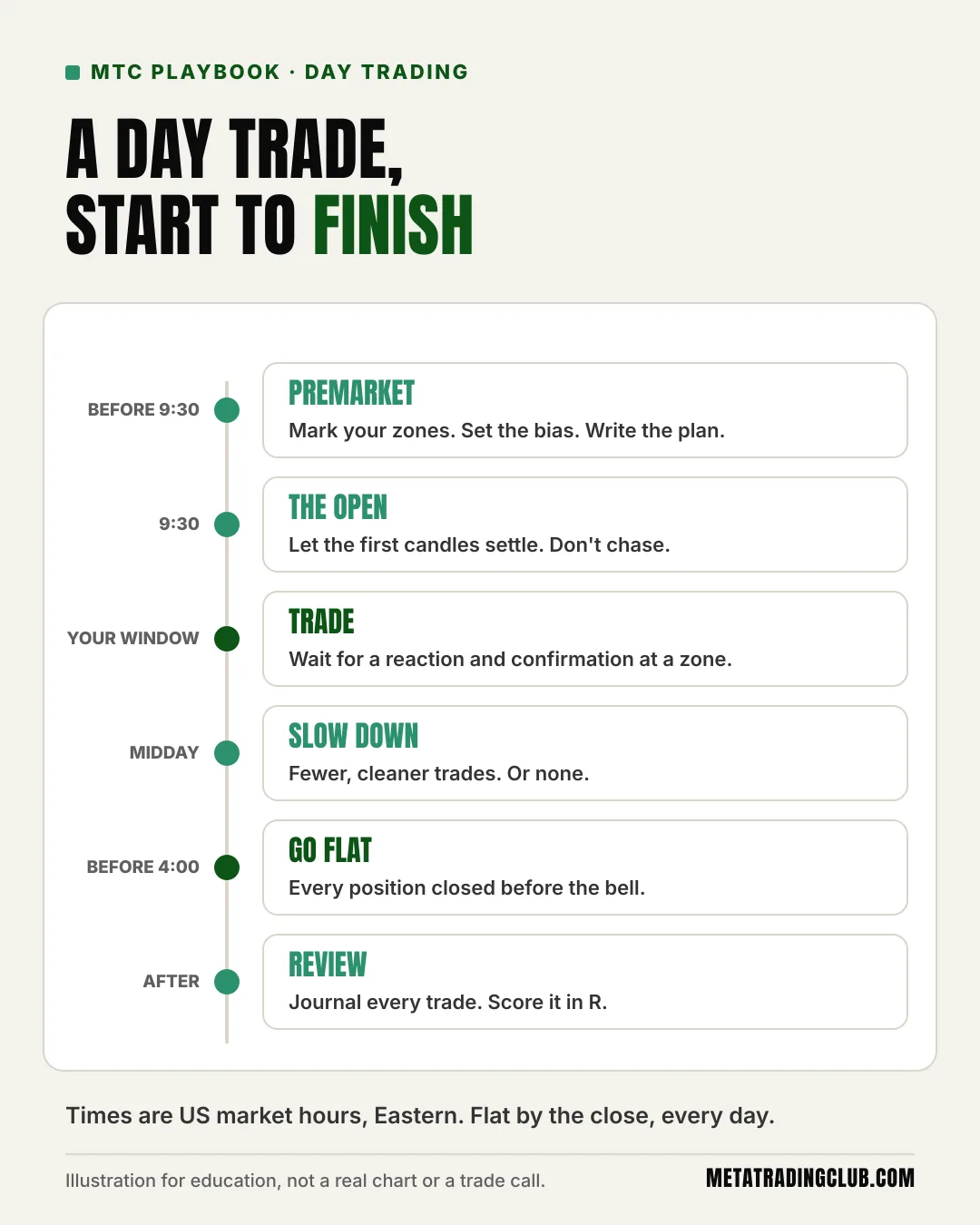
- Premarket: check the news, mark your support and resistance zones, and decide the bias for the day.
- The open: let the first candles settle. The open is fast and messy. Chasing it is how small accounts get hurt.
- Your trade window: only take trades that come to your zones and confirm. No setup, no trade.
- Midday: volume usually thins out. Trade less, or step away.
- Before the close: every position is closed. That’s what makes it day trading.
- After the close: journal every trade and score it in R. This is where you actually improve.
Day trading terms you need to know
- Bid, ask and spread: the best price buyers will pay, the best price sellers will take, and the gap between them. Tight spreads mean cheaper trades.
- Liquidity and volume: how easily you can get in and out. Day trade liquid names so your orders fill near your price.
- VWAP: the volume-weighted average price for the session. Many intraday traders use it as a reference line. Here’s how to trade VWAP.
- Stop loss: the price where your idea is wrong and you get out. Learn how to set a stop loss the right way.
- R: your risk on a trade. A +2R winner made twice what you risked. Measuring in R keeps you focused on process, not dollars. See reward-to-risk explained.
- Position size: how many shares or contracts you take so a loss stays at 1R. Our position sizing guide shows the math.
Common day trading setups
A setup is just a repeatable situation you’ve tested. Three that day traders use a lot:
- Breakout and retest: price breaks a zone, comes back to test it, and holds. You wait for the retest instead of buying the breakout. Full walkthrough: breakout and retest strategy and what a retest is.
- VWAP pullback: in a trending session, price pulls back to VWAP and holds it before continuing.
- Reversal at a zone: price runs into a strong zone, stalls, and confirms a turn. Know the difference between a reversal and a breakout before you trade either.
None of these work every time. They work as part of a process with fixed risk.
The 5 checks before every day trade
Before any day trade, run it through the same five checks. If one fails, you don’t take the trade.
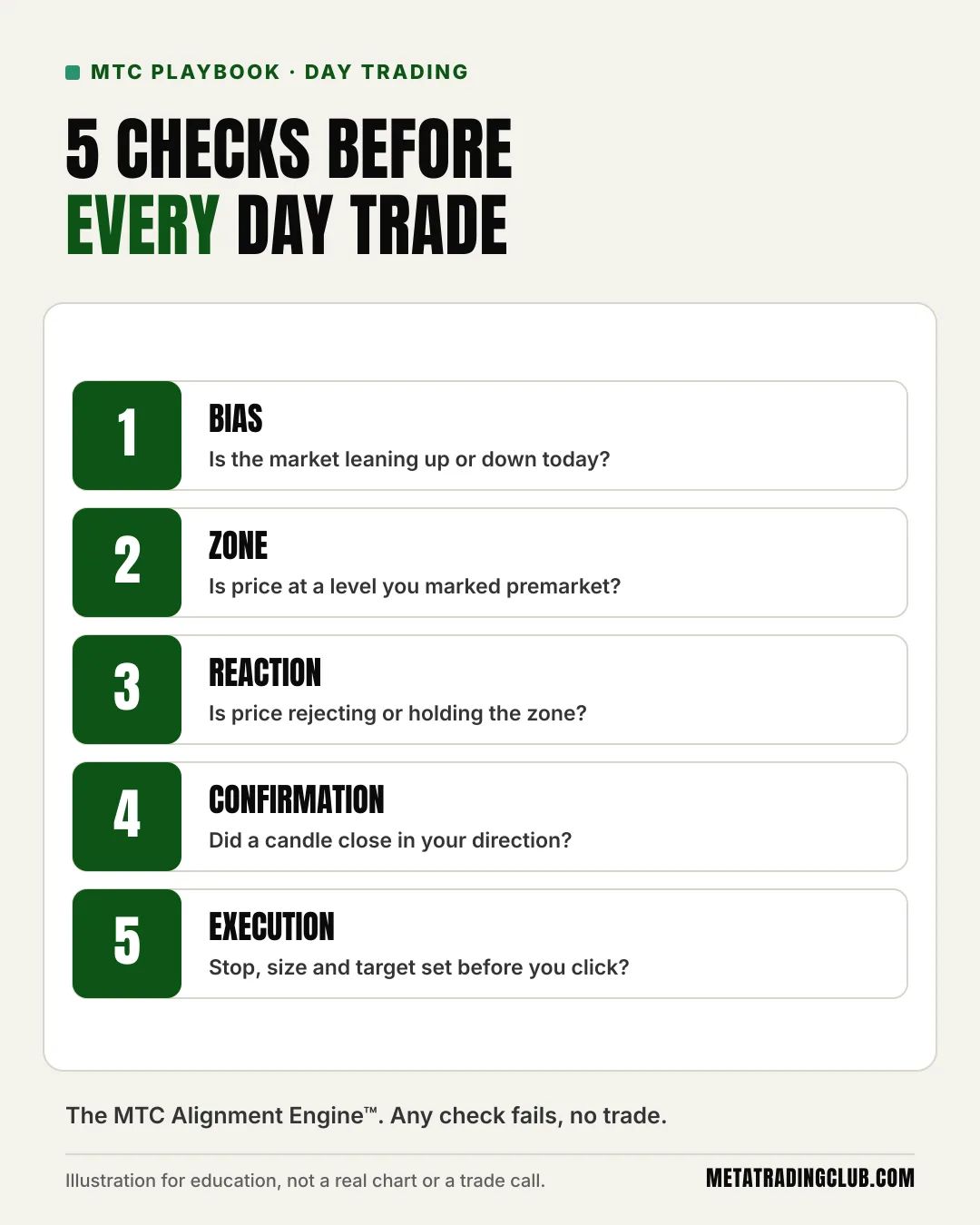
This is the MTC Alignment Engine™: Bias, Zone, Reaction, Confirmation, Execution. It’s slow on purpose. The goal is fewer, better trades, and a plan that’s fixed before emotions show up. If emotions are the problem, read how emotions ruin trades.
The MTC take: most day traders fail for one reason
The statistic everyone quotes — most day traders lose — is true, but the reason is misunderstood. They don’t fail because day trading doesn’t work. They fail because they trade without an edge, without risk control, and without a plan, treating it like a slot machine. Day trading done right is a business: a repeatable system, tight risk, and relentless execution. Build that, and you’re in the small group that lasts.
Frequently Asked Questions
Some links below are affiliate links — if you sign up through them, MTC may earn a commission at no extra cost to you. We only recommend tools we’d use ourselves.
Ready to put this into practice? You can open a brokerage account with a commission-free broker like moomoo and start small.